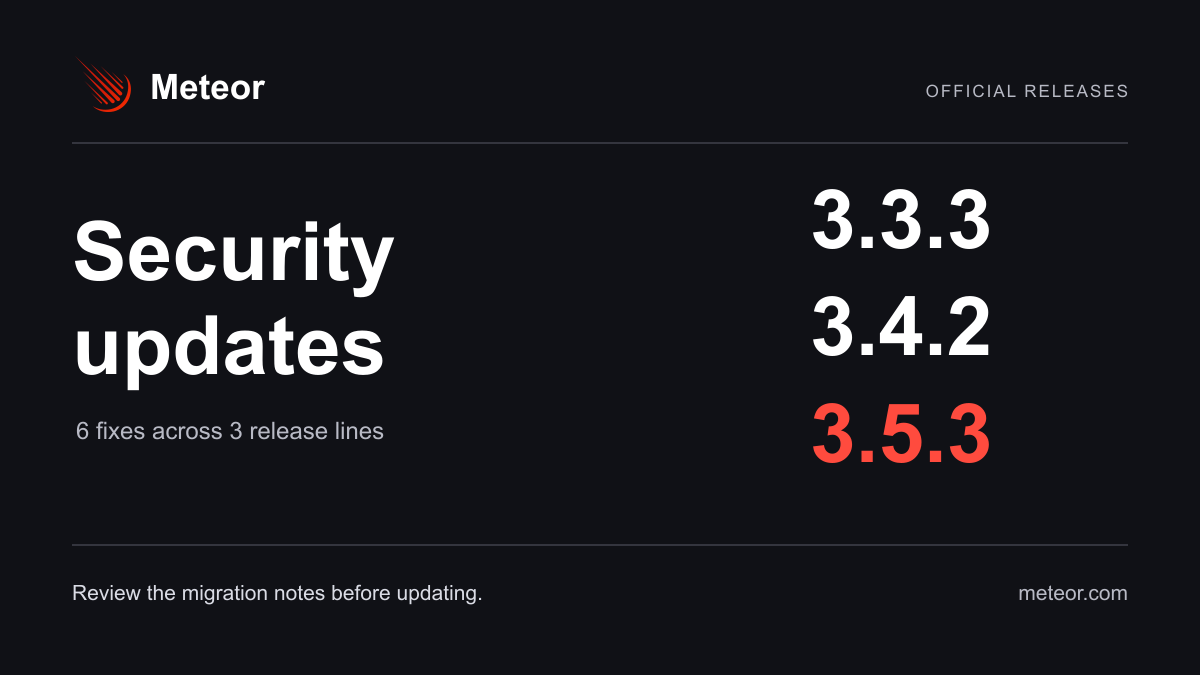
Meteor 3.3.3, 3.4.2, and 3.5.3 are now available as official security patch releases. Each includes the same six fixes, so you can update within the release line your application already uses.
CVE information
CVE identifiers for the security issues addressed in these releases will be published soon. The fixed releases are already available, so you can update your applications now.
These patches follow 3.3.2, 3.4.1, and 3.5.2 respectively. Node, npm, and the dev bundle remain unchanged within each line.
Choose your release line
Run the matching command in your existing application, or select the version explicitly when creating a new app:
| Current line | Security patch | Update an existing app | Create a new app |
|---|---|---|---|
| 3.3 | 3.3.3 | meteor update --release 3.3.3 |
meteor create my-app --release 3.3.3 |
| 3.4 | 3.4.2 | meteor update --release 3.4.2 |
meteor create my-app --release 3.4.2 |
| 3.5 | 3.5.3 | meteor update --release 3.5.3 |
meteor create my-app --release 3.5.3 |
The six fixes
- Google and Facebook login: validate direct-login tokens against the application’s OAuth configuration, use provider-verified Google identity fields, and prevent Facebook verification errors from exposing the app secret.
- DDP: prevent server crashes caused by invalid protocol-handler names and unhandled asynchronous handler rejections.
- Allow/deny: include every modified top-level field in update authorization checks.
- Dynamic imports: bound request size and complexity, batch large valid module graphs, and limit failed module reads and logging.
- Meteor shell: keep shell history and compilation caches private on POSIX systems, with graceful handling when private persistence is unavailable.
- Deploy: validate discovery-selected Galaxy HTTPS destinations before sending account credentials, while preserving HTTP discovery for first deploys.
Review before deploying
- Native Google sign-in: access-token sign-in without
serverAuthCodemust list the iOS/Android OAuth client IDs inadditionalClientIds, or supply a matching Google-validatedidToken. Request theemailandprofilescopes when those fields are needed. ID-token validation needs outbound access tooauth2.googleapis.com. - Dynamic imports: deploy the updated client and server together. Older open clients may need a refresh when loading a large uncached module graph. Oversized or malformed requests now receive HTTP 413 or 400.
- Allow/deny: review validators that depend on modified-field lists, which now include a top-level
__proto__field. - Custom deploy servers: select a custom server explicitly with
DEPLOY_HOSTNAMEand trust that destination before supplying credentials. Automatic discovery selects trusted Galaxy HTTPS deploy servers. - DDP extensions: define protocol handlers directly on the handler table; inherited handlers are no longer accepted.
Read the complete release notes for package versions and migration details:
These security corrections intentionally tighten behavior. Review the notes before rolling out the update, particularly if your application uses the affected configurations above.
Validation and feedback
Fresh application installation, bundled MongoDB reads and writes, and production builds passed on macOS ARM64 and Linux x86_64 using Ubuntu 22.04. Windows binaries are available; Windows installation and application tests were not part of this validation.
The bundled MongoDB did not start on the Ubuntu 20.04 test host because the required OpenSSL 3 and newer glibc libraries were unavailable. Check your deployment environment’s runtime requirements before updating an older Linux host. Each release keeps its line’s existing Node, npm, and dev bundle.
Please test your application’s sign-in flows, dynamic imports, authorization rules, and deployment process, and share your upgrade experience in this thread. Report regressions with a minimal reproduction when possible.
Thanks to Vext Labs for the OAuth disclosure, @italojs for implementing and adapting the fixes, and @Grubba27 and @nachocodoner for reviewing dynamic-import.
Sponsors
Thank you to our Supernova sponsors, Galaxy and Input Logic, and our Nebula sponsor, CodeRabbit, for their ongoing support of Meteor.
Their support helps sustain the framework’s development, maintenance, and security work. Learn more about the Meteor Sponsorship Program.