There is a new tool for running apps as a desktop app called Tauri. The benefit of this tool is performance, at least compared to electron. Has there been any taught on the meteor side of making this compatible or is there a way to integrate meteor with tauri?
1 Like
One option would be to use SimpleDDP package to connect Tauri desktop app to a Meteor backend.
Interesting package. How about having the client part of the app wrapped with Tauri (since one can use react for the UI).
An interresting thing. I think for the team this will become a question in Q2 2022, once Tauri reaches a stable release.
That would be great. It looks like they are already working on a stable release.
Yes, I saw it on their roadmap, so I thought that would be the best point to start investing resources into integration.
Verson 1.0 of tauri has been released. Any news on this?
2 Likes
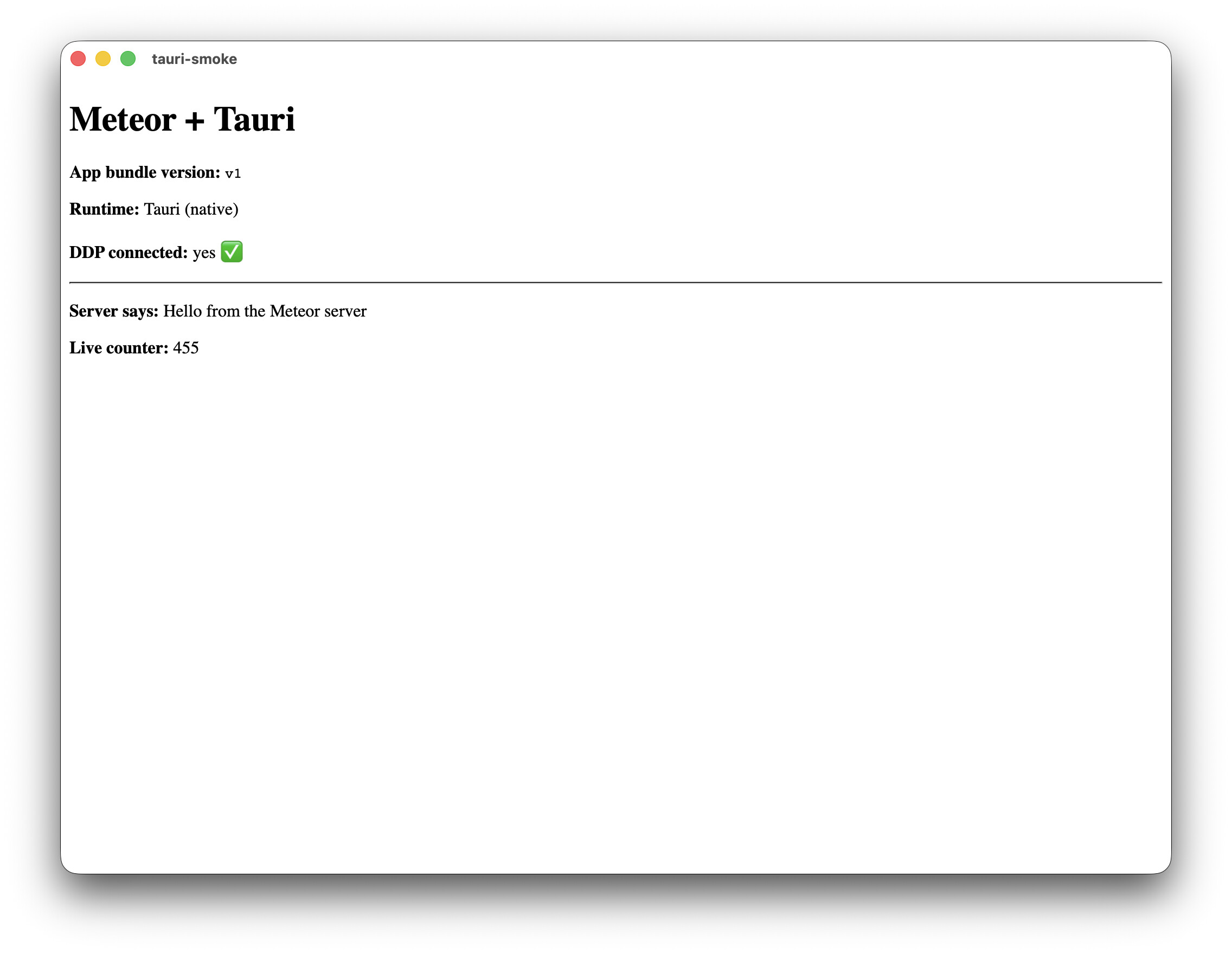
I ended up doing some work with Tauri for another project and thought “heck, why not try getting this INTO meteor…”
Would love some beta testers! It “works for me!” lol
1 Like
Maybe because we ElectronJS in Meteor 
If you want to give it a try: GitHub - a4xrbj1/meteor-desktop: Build a Meteor's desktop client with hot code push. · GitHub
There are numerous articles on the web for ElectronJS vs Tauri but a quick Gemini summary:
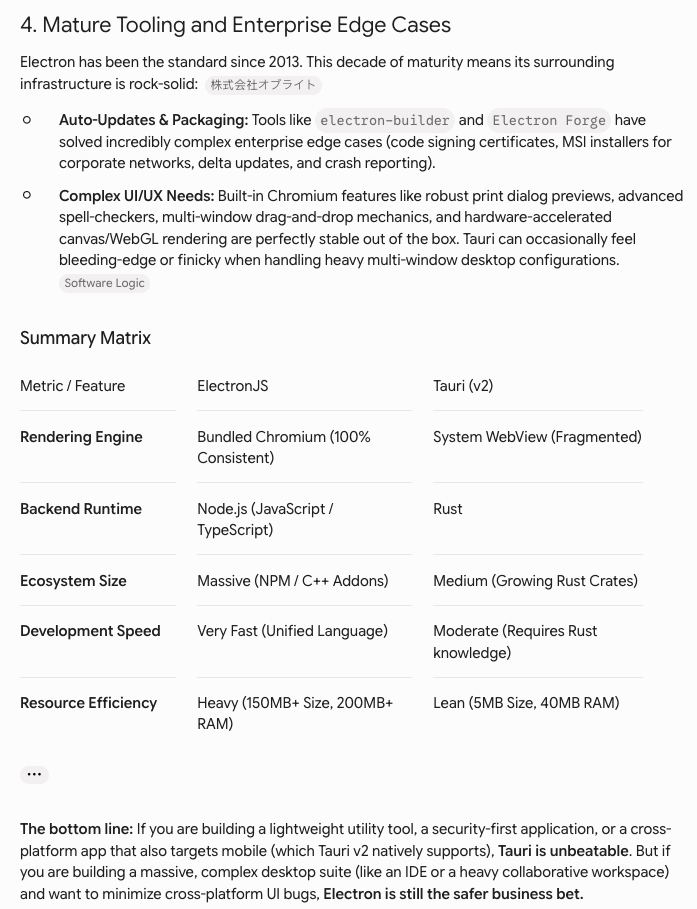
I’ve used meteor-desktop since 2016, very familiar with it! For the same 200+mb app I have it down to 27mb with Tauri. For auto-updates you can use Updater | Tauri which I am actively using and it works very well, too.
That’s not the same app (as you know it wasn’t maintained at all) anymore.
That’s probably one of the biggest advantages of Tauri.
In the end each developer/company has to make a decision what’s right for their use case. I’m running an Enterprise grade app, therefore it’s ElectronJS and Tauri is out.
The size of the desktop app isn’t a problem at all (it’s less than 300 Mb) in today’s world of computing power, internet speed, and disk space. The footprint of an ElectronJS app is actually a side effect of its biggest enterprise advantage: embedded dependency isolation.
By bundling a locked, specific version of Chromium and Node.js, Electron guarantees absolute runtime consistency. It completely eliminates environmental drift and OS-level fragmentation. It doesn’t matter what host OS version, unpatched WebView2 update, or corporate Linux distro the client is running—the rendering engine and V8 runtime are identical.
Tauri’s 27mb size is achieved by offloading the rendering engine to the host OS’s native webview (WebView2 on Windows, WebKit on macOS). While brilliant for consumer apps where download friction kills user acquisition, it introduces QA risk for enterprise environments. A silent OS background update that alters native webview behavior can introduce UI regressions or runtime bugs that break a critical business workflow.
For an enterprise-grade app where stability and predictable testing are the ultimate features, paying the “Chromium tax” in megabytes to eliminate native webview variables is a completely defensible, battle-tested decision.
1 Like